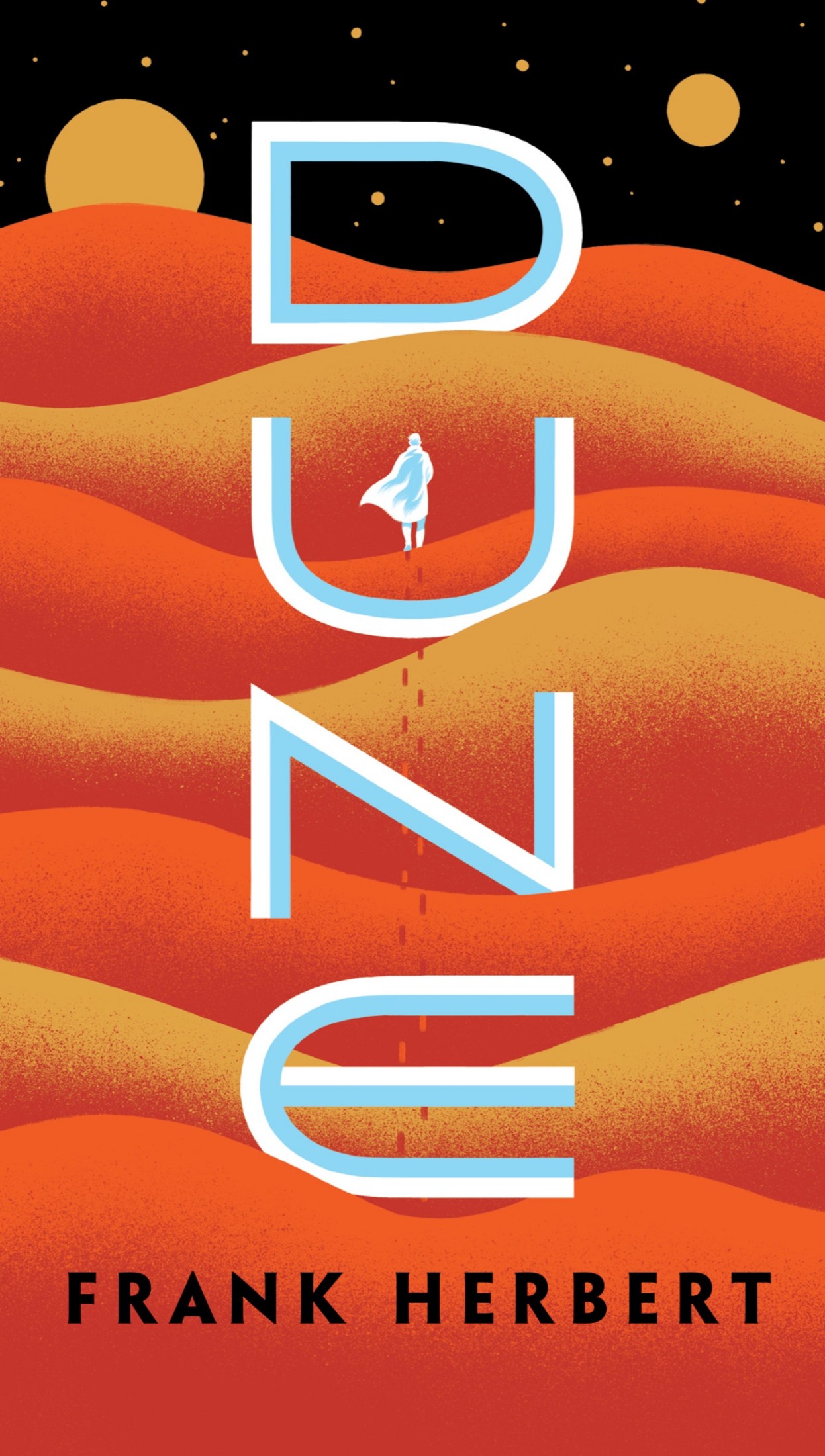
finished reading Dune 🌕🌕🌕🌕🌗
After about six weeks, I finally finished reading Dune, and I get it. I really get it. I didn't think I would, but I'm glad I do.
It's a genuinely good book from start to finish, and honestly hard to explain unless you read it. People call it the predecessor to a lot of modern science fiction, and you can see ideas here that inspired works that are now staples of the genre. But here in 2026, it's still pretty unique. There's not a lot like it. It could've been written today and still work. Frank Herbert was ahead of his time, and he made something genuinely timeless.
You basically need a dictionary. Every other page there's a word where I can't tell if it's a 1960s term, a science term, Herbert misusing a science term, or a made-up Dune word. Total crapshoot. Luckily my copy had a glossary in the back, which I didn't discover until I was two-thirds through, and I turned it into a quick-lookup dictionary on my reader. That added a lot.
You might hear "you need a glossary to understand this" and think the book's too dense to bother. I get that. But the world is rich. Rich, rich. Meticulous down to the ecosystem, the history, the characters, their motivations. You'll read a single page and get three people's dialogue, not just them talking, but their thoughts, their reactions, the real intent behind what was said. It's really unique. Someone could hear me describe this and go, "yeah, duh, that's what books do." I don't know. Mind you, I'm not the most well-read person, but I haven't read anything quite like this.
In a good way, the book has kind of ruined adaptations of Dune for me. They'll feel inferior in every way. Unless you're getting internal monologues, shifting perspectives, flashbacks, I don't think any other medium can capture it. That's my issue with the recent movies (haven't seen the 1984 one or the miniseries). Without major spoilers: the first two chapters just throw you into a world, sink or swim, figure out what's going on. But if you swim, it pays off, and you learn a ton about all these characters.
It really surprised me, even characters I didn't like. For the first two-thirds, every Paul chapter past the opening felt like "here's our special chosen boy, ready to LARP his way through every situation." But by the last stretch, even Paul won me over. He feels like a real, fleshed-out person. I feel like I know him.
This is a tangent, but bear with me. Think of the Tales of game series: Symphonia, Vesperia, Abyss. A lot of what's always irked me about those (and games like them) is that the opening sells you on this cool fantasy world you want to explore, and then you play it and it's tropey, shallow, paint-by-numbers. It falls apart behind the curtain. I don't buy the world they're selling.
I buy the world of Dune. Even when I thought I'd bounce off it, the first few chapters hooked me. Herbert isn't just telling Paul Atreides' story. He's telling the story of this entire universe through the lens of one planet. It's really interesting.
It's not perfect; no story is. Still excellent, near-perfect for what I want from entertainment, but not perfect. Some characters I don't think we needed. Some concepts just get thrown at you, and without the glossary I'd have been lost. Example: shields are force fields that block fast-moving objects, so bullets are useless. On Arrakis you can't use shields because the vibrations summon sandworms, a death sentence, established early. The capital city is surrounded by a "shield wall," which, turns out, is just a giant rock wall (worms don't like big rock structures). If you're not laser-focused, you might miss that "shield wall" isn't a shield at all. Maybe I'm just a dum-dum, but little things like that. A couple tweaked words could've thrown the reader a life preserver instead of leaving them stranded.
Maybe that's intentional. Maybe Herbert wanted readers to feel like Paul, thrust into Dune, lost and alone. Giving him too much credit? Maybe. But there are a few spots where I just think: define a term in text, just a couple, give us a break.
Those are minor nitpicks. In current year, this book is way more approachable than it would've been in the 60s. I really like it a lot. Can't sing its praises enough.
Next up: I'm playing the games, and for better or worse I'm ingesting the movies. Even though I despise how they tell the story, they nail the vibe visually and audibly. They're gorgeous, and seeing these characters through that lens is still a visual treat.
I'm curious about the later books. Herbert wrote about six; I'll try to work through them, or read some, put the series on hold, pick them back up. Depends on burnout. Mixed things about the ones his son Brian wrote. I'm a fan of franchises that end instead of dragging on forever. Tell good stories, flesh them out, move on to new ones. So we'll see how deep I go into the extended universe.
Overall: great book. Recommend it. Glad I gave it a shot, and looking forward to reading more.